Hair Transplant Recovery Timeline: What to Expect After 1 Week, 1 Month, 6 Months & 1 Year
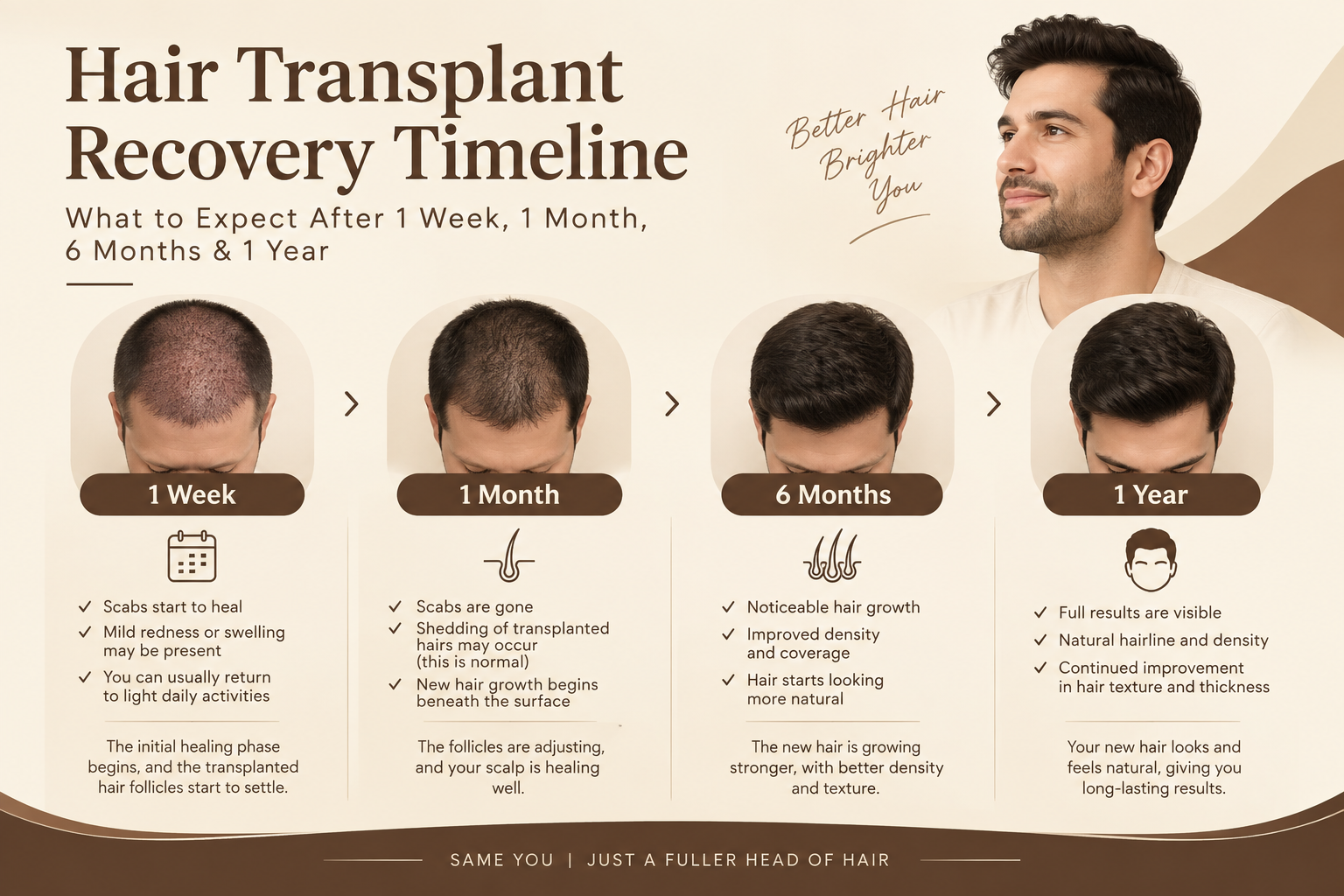
If you're planning a hair transplant, one question arises more frequently than any other: "How long until I see results?" Understanding the hair transplant recovery timeline helps you set realistic expectations, avoid unnecessary panic during the awkward in-between phases, and take the right care of your scalp at every stage.
This guide walks you through the complete hair transplant healing process — day by day, week by week, and month by month — so you know exactly what's normal and what needs a doctor's attention.
How Long Is the Hair Transplant Recovery Time?
The full hair transplant recovery time varies from person to person, but most patients follow a similar pattern:
Initial healing: 10–14 days
Shedding and "ugly duckling" phase: 3–4 months
Visible new growth: 4–6 months
Final, mature results: 12–18 months
Genetics, the transplant technique used (FUE or FUT), graft density, and how well you follow aftercare instructions all affect your personal hair transplant timeline month by month. Let's break down each stage in detail.
Hair Transplant Recovery Week 1: The First Few Days
What happens during hair transplant recovery week 1?
The first week is all about protecting the newly placed grafts and managing normal post-surgical symptoms.
Days 1–3: Mild swelling on the forehead and around the eyes is common, especially after FUT or larger sessions. Redness and tenderness at both the donor and recipient areas are normal.
Days 4–7: Tiny scabs form around each graft. This is a sign of healing, not a problem.
What does hair transplant 1 week after look like?
By day 7, most of the swelling has gone down, and the scabs are starting to loosen. Your scalp may still look red or scabby, but the transplanted hairs are securely anchored by now (usually by day 10, grafts are firmly rooted and safe from being dislodged).
Early aftercare tips for week 1:
Sleep with your head elevated for the first 3–5 nights
Avoid touching or scratching the grafts
Follow your surgeon's washing schedule exactly
Skip strenuous exercise, sun exposure, and alcohol
Hair Transplant Scab Healing Time
Most scabs fall off naturally within 7–14 days. Gently washing with a mild, prescribed shampoo speeds this up. Picking at scabs can damage grafts, so patience here matters more than anything else.
The Shock Loss Phase: A Normal (but Scary) Part of the Process
What is hair transplant shock loss timeline?
Around 3–8 weeks post-surgery, many patients notice the transplanted hairs falling out. This is called "shock loss," and it's completely normal — the hair follicle stays alive under the skin even though the visible strand sheds.
This period is often nicknamed the hair transplant ugly duckling phase, roughly between month 2 and month 4, when hair looks patchy, thinner, or uneven before new growth kicks in. It's the hardest phase emotionally, but it's a well-documented and temporary part of the hair transplant growth stages.
Hair Transplant 1 Month Results
What can I expect from hair transplant 1 month results?
By the one-month mark:
Scabs are completely gone
Redness has mostly faded
Shedding of transplanted hair may have already started for some patients
Many people search for hair transplant after 1 month photos online, and it's important to know — this is usually the least impressive stage visually. Don't judge your results at this point; the real growth hasn't started yet.
Hair Transplant Swelling: How Long Does It Last?
Swelling typically peaks around day 3–4 and resolves within 7–10 days. If swelling persists beyond two weeks or is accompanied by fever or unusual discharge, contact your clinic immediately.
When Does Hair Transplant Hair Start Growing?
New hair growth generally begins between month 3 and month 4. It starts fine, thin, and sparse — much like baby hair — before thickening over the following months.
Hair Transplant 6 Months Results
What should I expect at the hair transplant 6 months results stage?
This is where the transformation becomes noticeable:
Around 50–60% of new hair has usually grown in
Hair texture starts to normalize
Density visibly improves, though it's still not the final look
Patients often say this is the point where friends and family start noticing a difference without being told.
Hair Transplant Timeline Month by Month (Quick Reference)
Month | What to Expect |
|---|---|
Month 1 | Scabs gone, possible shedding begins |
Month 2–3 | Ugly duckling phase, minimal visible hair |
Month 4 | New growth starts, fine and thin |
Month 6 | 50–60% growth, visible density improvement |
Month 9 | Hair thickens further, natural texture returns |
Month 12 | Majority of results visible |
Month 18 | Final, fully mature results |
Hair Transplant 1 Year Results
Are hair transplant 1 year results the final outcome?
At 12 months, most patients see roughly 80–90% of their final results. Hair looks fuller, more natural, and styleable. However, small improvements in thickness and texture can continue for a few more months.
Hair Transplant Final Results Timeline
When will I see the true final results?
The hair transplant final results timeline typically completes between 12 and 18 months after surgery. This is when the transplanted hair reaches its full thickness, natural growth pattern, and permanent density — the look you'll carry long-term.
How Long for Hair Transplant to Fully Grow?
On average, it takes 12–18 months for hair to fully grow and mature. Some patients with a higher number of grafts or a naturally slower growth cycle may take slightly longer to see complete results.
FUE Hair Transplant Recovery: Is It Faster Than FUT?
Does FUE hair transplant recovery take less time?
Yes, generally. FUE (Follicular Unit Extraction) doesn't require a linear incision, so:
Less swelling and bruising
Little to no visible linear scarring
Faster return to daily activities, often within 3–5 days
FUT recovery, while similar in overall timeline, usually needs a bit more downtime for the donor area strip incision to heal.
Hair Transplant Recovery Day by Day (First 10 Days)
Day 1: Redness, tightness, mild swelling begins
Day 2–3: Peak swelling, especially near forehead
Day 4–5: Swelling reduces, itching may start
Day 6–7: Scabs form and begin to loosen
Day 8–10: Most scabs shed, grafts are secure
Hair Transplant Recovery Week by Week (First Month)
Week 1: Swelling, scabbing, and initial healing
Week 2: Scabs gone, scalp looks pink or normal
Week 3: Scalp mostly settled, minor shedding may start
Week 4: Shedding phase begins for many patients before regrowth
Hair Transplant Aftercare Tips for Faster, Safer Healing
Follow the exact washing routine given by your surgeon
Avoid direct sun exposure for at least 4 weeks
Skip gyms, swimming, and heavy sweating for 2–3 weeks
Don't wear tight caps or helmets until cleared
Stay hydrated and eat a protein-rich diet to support hair growth
Attend every follow-up appointment so your surgeon can track your hair transplant results timeline
Hair Transplant Before and After: What Real Progress Looks Like
When comparing hair transplant before and after photos, always check the timestamp. A photo taken at 3 months will look very different from one taken at 12 months. Genuine, credible results should always be labeled with the exact month post-surgery for a fair comparison.
Choosing the Right Clinic Matters for Your Recovery
A smooth hair transplant healing process depends heavily on the skill of your surgical team and the quality of aftercare guidance you receive. If you're researching a hair transplant clinic in Jaipur, look for a facility that offers:
Experienced surgeons with visible before-and-after case studies
Clear, written aftercare instructions
Transparent graft-counting and pricing
Easy access for follow-up visits during your recovery months
Finding the best hair transplant doctor in Jaipur isn't just about the surgery day — it's about having a team that supports you through the entire recovery, from week 1 scabbing to the final results at month 18.
Final Thoughts
The hair transplant recovery timeline isn't a straight line — it has ups (early healing), downs (the ugly duckling phase), and a satisfying payoff (natural, dense hair by month 12–18). Knowing what to expect at each stage — 1 week, 1 month, 6 months, and 1 year — helps you stay patient and confident through the process instead of worrying over normal, temporary changes.
If you're considering the procedure, consult a qualified surgeon who can walk you through your personal recovery plan based on your hair loss pattern, graft count, and technique.
Frequently Asked Questions
Q: Is pain common during hair transplant recovery? A: Mild discomfort is normal for the first 2–3 days, usually managed with prescribed painkillers. Severe pain is not typical and should be reported to your surgeon.
Q: Can I go back to work after a hair transplant? A: Most patients return to desk jobs within 3–7 days, once scabbing has reduced and swelling has settled.
Q: Will all my transplanted hair fall out during shock loss? A: Not all of it — but a noticeable portion may shed temporarily between weeks 3–8 before regrowing permanently.
Q: Is the ugly duckling phase the same for everyone? A: The timing and intensity vary, but most patients experience some version of it between months 2 and 4.